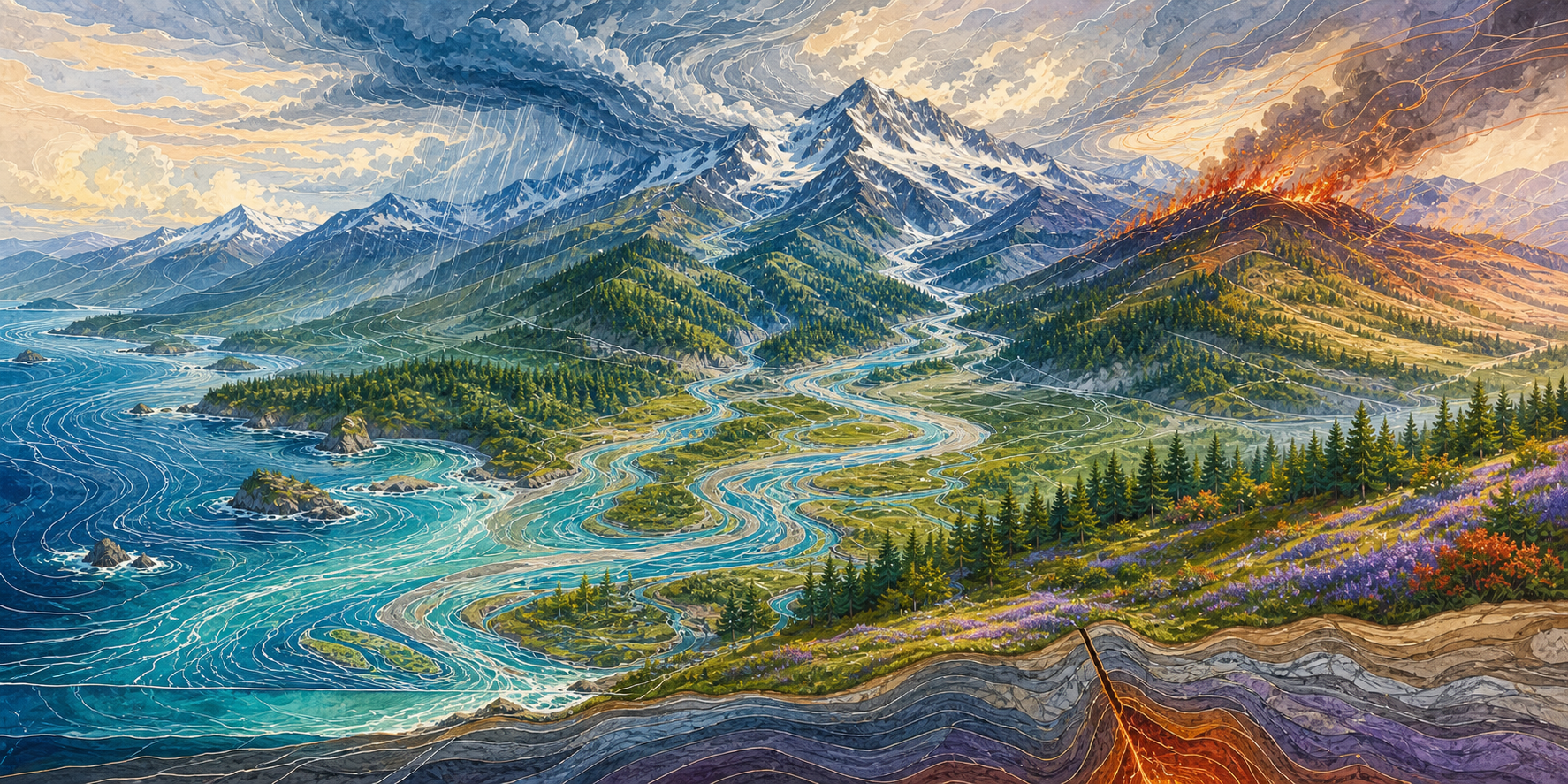
Four threats, specific to the Cascadia bioregion — from northern California through Washington and Oregon to coastal British Columbia. Each guide walks you through what it is, what the first hours look like, what to do, and what to have ready.
The Cascadia Subduction Zone has been building pressure for over 300 years. What a major earthquake looks like in Seattle, Portland, and the coast — and what to do in the first fifteen minutes.
Who should read this: Everyone west of the Cascades — from northern California through Oregon and Washington to Vancouver and coastal British Columbia. Especially if your home was built before 1970 or sits on fill soil.
You'll learn: What the Cascadia Subduction Zone is and why it matters. What liquefaction means for your neighborhood. How to retrofit your home. What David in Fremont did in the first eight minutes — and why his neighbors needed him.
Hotter summers, drier forests, longer fire seasons. If you live east of the Cascades or in the wildland-urban interface, this isn't abstract. How to prepare, when to leave, and what to take.
Who should read this: Anyone east of the Cascades, in the foothills, or in rural areas surrounded by forest. If you can see trees from your house and you live in Washington or Oregon, this applies to you.
You'll learn: How wildfire actually reaches houses (hint: it's embers, not the fire front). What defensible space means in practice. Why Rosa and James outside Leavenworth had nine minutes to leave — and why nine minutes was enough.
Ice storms, atmospheric rivers, days without power. For rural households and island communities, winter isn't cozy — it's a test of whether you thought ahead.
Who should read this: Rural households, island communities, anyone who heats with electricity, and anyone whose driveway passes through trees. If "three days without power" is something that has happened to you or could, this is your guide.
You'll learn: Why PNW ice storms are different from blizzards. What happens to your house when the power has been off for 18 hours. How Nora on Lopez Island spent four days without power — comfortably — while her neighbor almost didn't.
Atmospheric rivers, rising rivers, and the slow emergency that gives you hours of warning — if you know where to look. How to read the gauge, protect your home, and leave when it's time.
Who should read this: Anyone in a river valley or floodplain — Chehalis, Snoqualmie, Skagit, Nooksack, the lower Fraser in BC. If your neighborhood has flooded before, or if you don't know whether it has, this is your guide.
You'll learn: Why PNW flooding is getting worse. How to read a USGS river gauge. What Tom and Maria in the Chehalis valley did with four hours of warning — and why those four hours were enough.
Each guide follows the same structure. First, you'll experience what the event feels like through the eyes of someone who lives here — a real scenario grounded in real PNW geography. Then I explain the science: what's happening and why. Then practical steps: what to do before, during, and after. Then supplies: what to have ready, where to find it, and why each item matters.
Every guide ends with the same person from the opening. They're okay. They were ready. You can be too.
When you're ready to act, the Build Your Kit page has the full supply checklists — printable, organized by threat, with sourcing suggestions.